明日は雨だと思います。
I think it will rain tomorrow.
Noun + だと思います.
 Japanese by CCNJapanese for life in JapanAdd on LINE
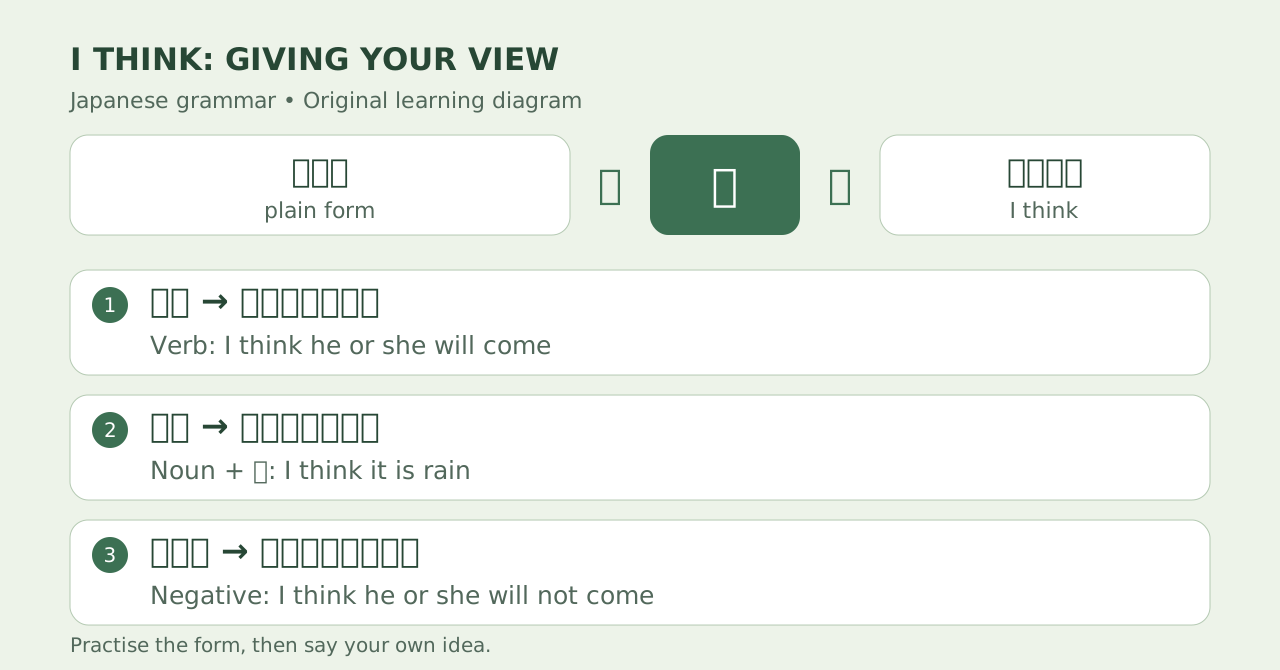
Share your opinion or guess with と思います. Put the plain form before と, and keep 思います at the end.
『〜と思います』は、自分の考えや予想を言うときに使います。『と』の前は普通形です。

Use plain form + と + 思います. The part before と says what you think. 思います shows that it is your own opinion or judgment, not a fact everyone knows.
普通形に『と思います』を付けて、自分の考えを言います。
A verb takes its dictionary form: 来ます becomes 来る, so say 来ると思います. A noun adds だ: 雨だと思います. An i-adjective stays the same: おもしろいと思います. Do not put the polite です or ます before と in this pattern.
『来る』『雨だ』『おもしろい』のような形の後に、『と思います』を付けます。『雨ですと思います』にはなりません。
Put the ない-form before と: 来ないと思います means I think someone will not come. Compare 来ると思います, which means I think someone will come.
来ると思います。来ないと思います。『ない』があるかないかで、意味が反対になります。
Use 思います when you give a view or a guess, such as a rough time. For a fact you know well, say the sentence without it. Words such as たぶん (probably) and ぐらい (about) make the guess clearer. When someone asks you a question at a counter, you can answer with this pattern. A plan such as 〜(よ)うと思います uses a different verb form and is not covered here.
よく知っていることには、『と思います』は使いません。『たぶん』や『ぐらい』を付けると、はっきりしない気持ちが伝わります。
These scenes and exercises are fictional examples written for this lesson.
明日は雨だと思います。
I think it will rain tomorrow.
Noun + だと思います.
この本はおもしろいと思います。
I think this book is interesting.
I-adjective + と思います.
田中さんは10時ごろ来ると思います。
I think Tanaka-san will come around ten o’clock.
Verb (dictionary form) + と思います. ごろ means around.
今日は友だちは来ないと思います。
I think my friend will not come today.
来ない is the ない-form of 来る.
Say your answer before opening the explanation.
Q1. Complete: 明日は雨( )と思います。
だ
雨 is a noun, so add だ before と.
Q2. Choose: おもしろいと思います / おもしろいだと思います。
おもしろいと思います。
Keep the i-adjective as it is and add と.
Q3. Say that you think a friend will not come.
友だちは来ないと思います。
Use the ない-form 来ない before と.
Q4. Make a sentence about what you think will happen tomorrow. Example answer:
明日は友だちが来ると思います。
Other sentences are possible. Use the plain form before と.
| Japanese | English |
|---|---|
| 思います | think |
| 明日 | tomorrow |
| 雨 | rain |
| 友だち | friend |
| 来ます | come |
すみません、たぶん10時ごろだと思います。
Excuse me, I think it is probably around ten o’clock.
Grammar reference: The Japan Foundation, Irodori: Japanese for Life in Japan, Elementary 1. Explanations are concise original summaries; practice examples are original.