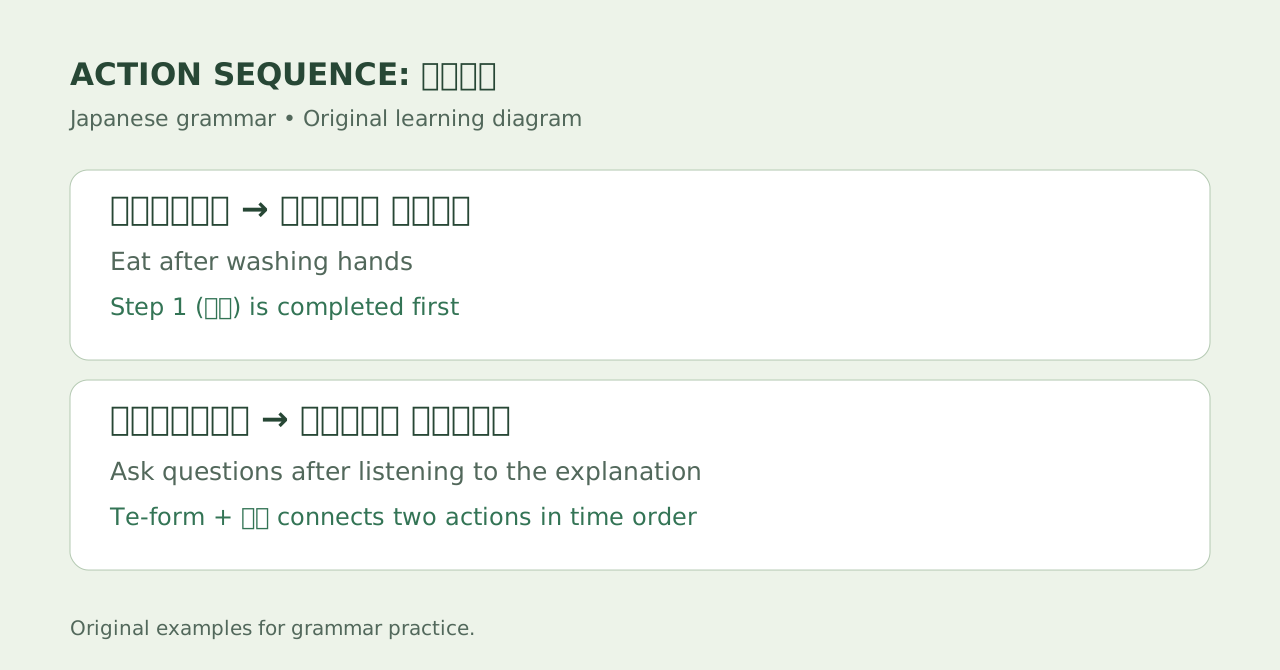
手を洗ってからご飯を食べます。
I wash my hands before eating meals.
食事の前の習慣を伝える場面です。
 Japanese by CCNJapanese for life in JapanAdd on LINE
Use the verb te-form followed by から to express that you complete action A first, and then proceed to action B.
『手を洗ってから食べます』のように、ひとつの行動をしてから次の行動をすることを伝えます。
Change the first verb into its te-form and add から: 洗ってから、見てから、読んでから. The second action happens only after the first one is completed.
最初の動詞をテ形にして「から」をつけます。「洗ってから」「見てから」のように言います。
The tense of the sentence is set by the final verb, not the te-form verb. 洗ってから食べました (past) / 洗ってから食べます (non-past).
過去か未来かは、文の最後の動詞で決まります。「洗ってから食べました」は過去です。
〜てから often emphasizes that action A is a prerequisite or condition before action B can take place.
「AをしてからBをする」という大切な順番や条件をはっきり伝えます。
Be careful: verb-dictionary-form + から or noun + だから expresses a reason ("because"). Verb-te-form + から expresses time sequence ("after doing").
理由を言う「から」と形が違います。テ形のあとの「から」は時間の順番を表します。
These scenes and exercises are fictional examples written for this lesson.
手を洗ってからご飯を食べます。
I wash my hands before eating meals.
食事の前の習慣を伝える場面です。
説明を聞いてから質問してください。
Please ask questions after listening to the explanation.
職場や教室で指示を出す場面です。
仕事が終わってから買い物に行きました。
I went shopping after finishing work.
1日の予定の流れを報告する場面です。
よく考えてから返事をします。
I will reply after thinking it through carefully.
大切な相談への対応を伝える場面です。
Say your answer before opening the explanation.
Q1. Choose the correct form for "after eating": 食べてから / 食べるから。
食べてから。
Use the te-form plus から for an action sequence.
Q2. Complete the sentence for "I wash hands and then eat": 手を( )から食べます。
洗って
The te-form of 洗います is 洗って.
Q3. In 確認してから送りました, which action happened first?
確認です。
確認 comes before 送りました in time.
Q4. Say in Japanese: "Please read after opening."
開けてから読んでください。
The te-form of 開けます is 開けて.
| Japanese | English |
|---|---|
| 洗う | wash |
| 順番 | order; sequence |
| 説明 | explanation |
| 確認 | confirmation; checking |
| 返事 | reply; answer |
手を洗ってから食べましょう。
Let's wash our hands before eating.
Grammar reference: The Japan Foundation, Irodori: Japanese for Life in Japan, Elementary 2. Explanations are concise original summaries; practice examples are original.