このパン、おいしそうですね。
This bread looks delicious.
An impression from appearance.
 Japanese by CCNJapanese for life in JapanAdd on LINE
Use an adjective plus そうです to describe an impression from appearance. This lesson practises appearance, rather than reporting information you heard.
見たときの印象を、『おいしそうです』『元気そうです』のように言います。

おいしい→おいしそうです、辛い→辛そうです. Do not leave the final い before そう in this appearance pattern.
『おいしいそうです』ではなく、『おいしそうです』を練習します。
元気→元気そうです. Do not insert な or だ immediately before そうです in this pattern.
『元気なそうです』『元気だそうです』とは形が違います。この課では見た印象を言います。
おいしそうなパン means bread that looks delicious. Compare おいしそうです at the end of a sentence with おいしそうなパン before a noun.
文の終わりは『おいしそうです』、名詞の前は『おいしそうなパン』です。
A dish can look spicy before you taste it. 辛そうです describes that impression; 辛いです states that it is spicy. Practise using the phrase without treating the impression as proof.
『辛そうです』は、見たときの印象です。食べて確かめたことと分けて考えましょう。
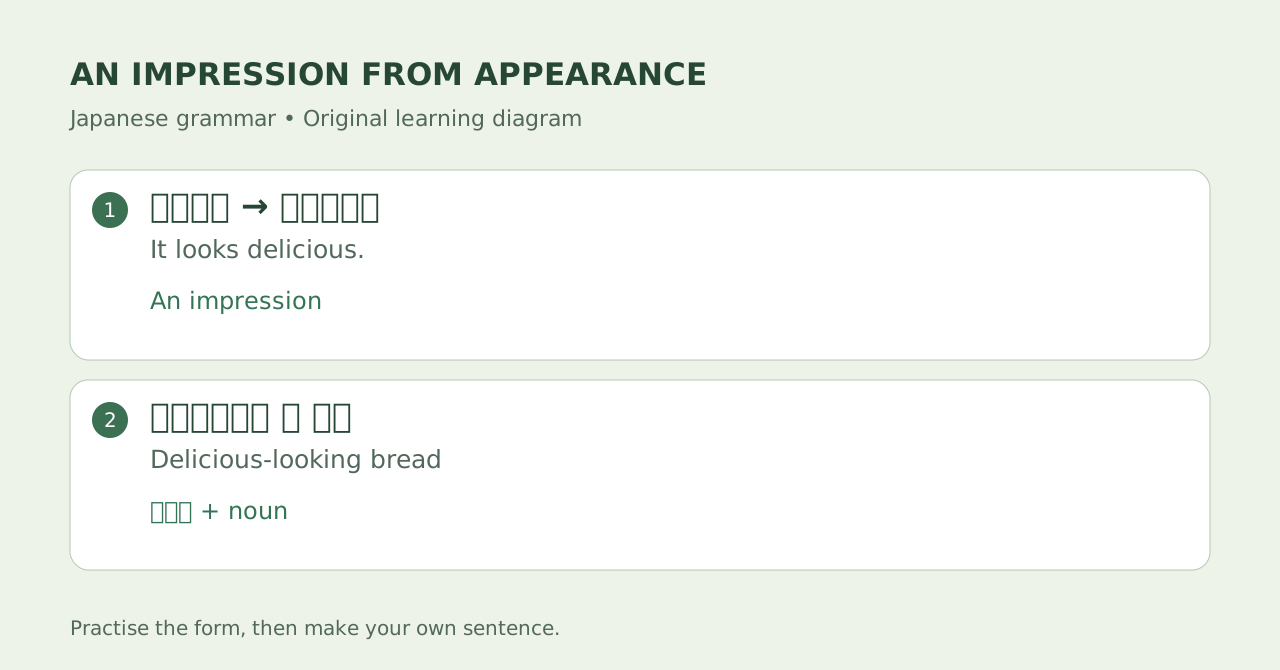
These scenes and exercises are fictional examples written for this lesson.
このパン、おいしそうですね。
This bread looks delicious.
An impression from appearance.
その料理は辛そうです。
That dish looks spicy.
辛い loses its final い.
今日は元気そうですね。
You look well today.
元気 is a na-adjective.
おいしそうなパンを見つけました。
I found some delicious-looking bread.
Use そうな before a noun.
Say your answer before opening the explanation.
Q1. Make the appearance form of おいしい。
おいしそうです。
Remove the final い.
Q2. Choose: 元気そう / 元気なそう。
元気そう。
Do not put な directly before そう.
Q3. Complete: おいしそう( )パン。
な
そうな modifies a noun.
Q4. Does 辛そうです prove that the speaker has tasted the dish?
いいえ。
It can describe an impression before tasting.
| Japanese | English |
|---|---|
| 印象 | impression |
| 料理 | dish; cooking |
| 辛い | spicy |
| 元気 | well; energetic |
| 見つけます | find |
そのパン、おいしそうですね。
That bread looks delicious.
Grammar reference: The Japan Foundation, Irodori: Japanese for Life in Japan, Elementary 1. Explanations are concise original summaries; practice examples are original.