このスープには野菜が入っています。
This soup contains vegetables.
A description of the contents.
 Japanese by CCNJapanese for life in JapanAdd on LINE
Compare ingredients that are already in a dish with ingredients someone intentionally puts in. Choose the verb and particle together.
『野菜が入っています』は今の中身、『野菜を入れます』は入れる動作を伝えます。

Nが入っています describes something being inside. In a food example, it describes the ingredients currently contained in a dish.
『スープに野菜が入っています』は、スープの中身の説明です。
Nを入れます describes a person putting something in. Pair を with 入れる when the noun is the thing being added.
『スープに野菜を入れます』は、野菜を加える動作です。
The sentences below are fictional grammar practice. For real food, ask or read the actual label; this page does not verify ingredients or allergy safety.
実際の料理の中身は、この例文から判断できません。
入る and 入れる form a pair of intransitive and transitive verbs. This lesson practises this pair, not a rule that all verbs ending in る have the same meaning.
『入っています』と『入れます』を、助詞と一緒に練習しましょう。
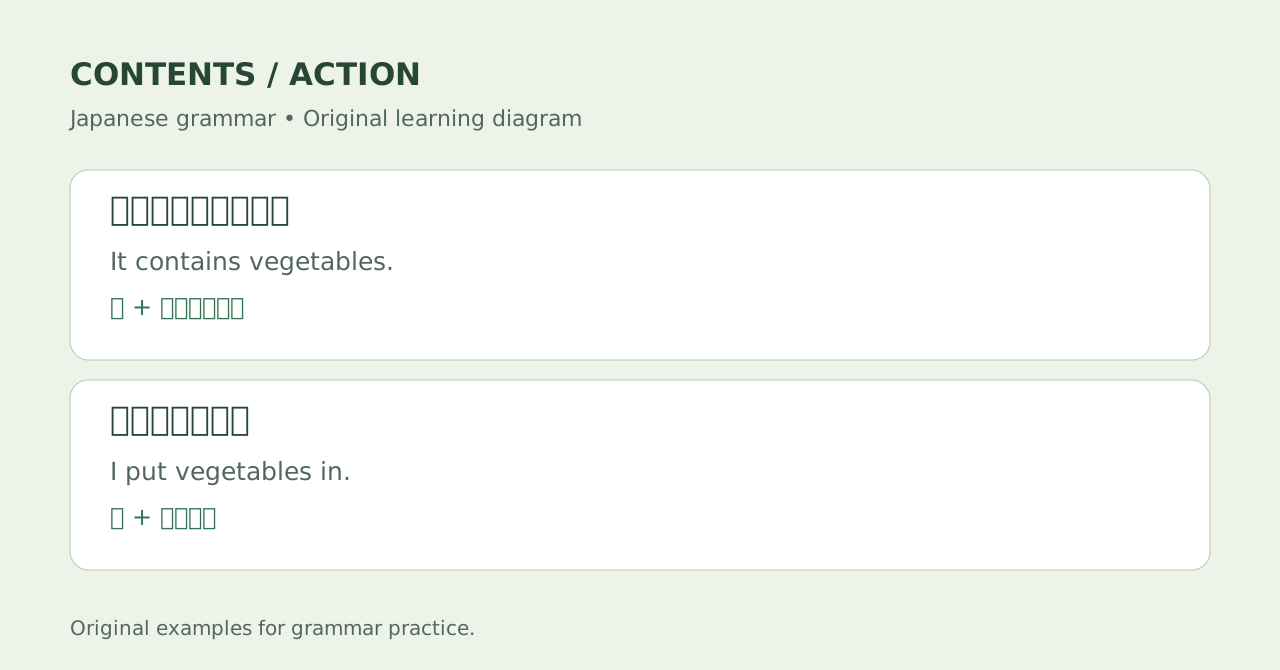
These scenes and exercises are fictional examples written for this lesson.
このスープには野菜が入っています。
This soup contains vegetables.
A description of the contents.
スープに野菜を入れます。
I put vegetables into the soup.
An intentional action.
この箱には本が入っています。
There are books inside this box.
The books are already inside.
この箱に本を入れます。
I put a book into this box.
The book is being put in.
Say your answer before opening the explanation.
Q1. Choose the particle: スープに野菜(が/を)入っています。
が
入っています describes the contents.
Q2. Choose the particle: 箱に本(が/を)入れます。
を
入れます describes putting the book in.
Q3. Does 野菜が入っています necessarily mean someone is adding vegetables now?
いいえ。中身の状態を表します。
It describes what is already inside.
Q4. Say that you put vegetables into soup.
スープに野菜を入れます。
Use を入れます for the action.
| Japanese | English |
|---|---|
| 入ります | enter; go in |
| 入れます | put in |
| 野菜 | vegetables |
| 箱 | box |
| 中身 | contents |
何が入っていますか。
What is inside?
Grammar reference: The Japan Foundation, Irodori: Japanese for Life in Japan, Elementary 1. Explanations are concise original summaries; practice examples are original.