窓口で、自分の名前を書くことができます。
I can write my own name at the counter.
V-ることができます.
 Japanese by CCNJapanese for life in JapanAdd on LINE
Say what you can or cannot do with V-ることができます or the potential form (読める, 見られる). Both can describe ability or what is possible in a situation.
『書くことができます』『読めます』『見られます』を比べます。『できる』を言う形を練習しましょう。
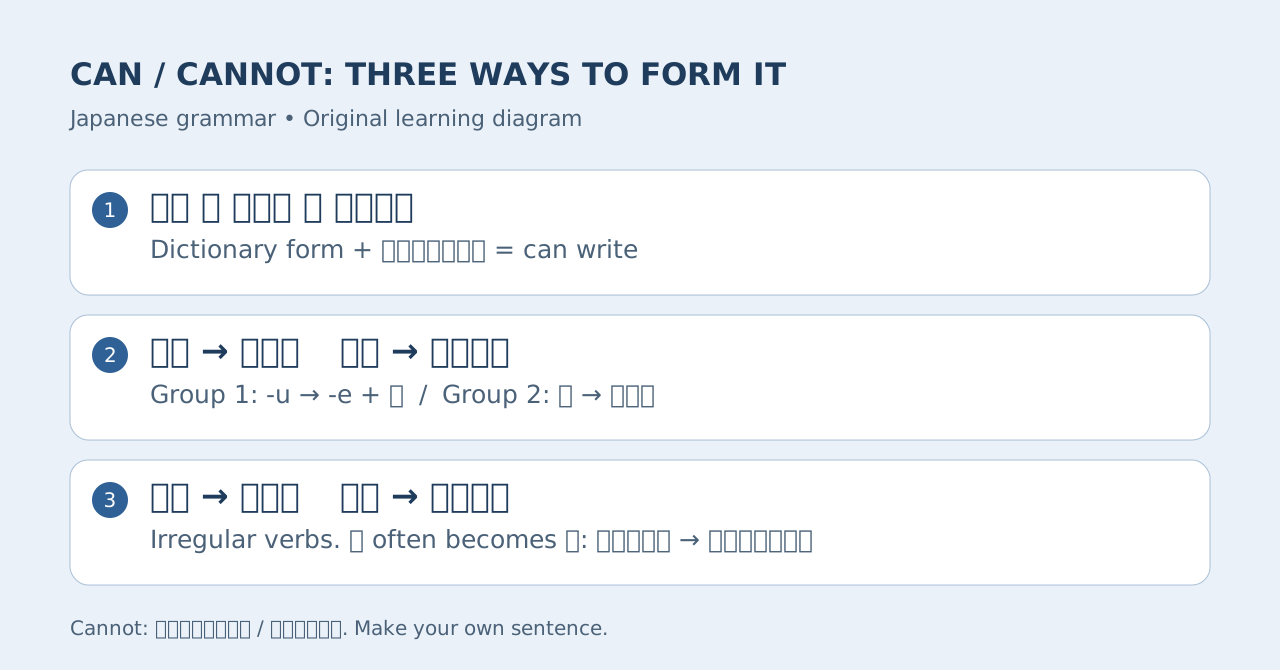
書くことができます means I can write. Use the dictionary form of the verb, then ことができます. It can show a person's ability, or that an action is possible in a situation. To say cannot, use ことができません.
辞書形に『ことができます』をつけます。『書くことができません』は「できない」という意味です。
Change the final -u to -e and add る: 読む → 読める, 持つ → 持てる, 飲む → 飲める. The polite forms are 読めます and 持てません.
1グループの動詞は、最後の「う」の音を「え」の音にして、『る』をつけます。
Drop る and add られる: 見る → 見られる, 食べる → 食べられる. In casual speech, 見れる and 食べれる are also used.
2グループの動詞は、『る』を取って『られる』をつけます。話す言葉では『見れる』とも言います。
する → できる and 来る → 来られる (来れる in speech). With the potential form, the object often takes が instead of を: 番号を見る → 番号が見られる.
『する』は『できる』になります。『を』は『が』に変わります。次の図で、形を見てから練習しましょう。
These scenes and exercises are fictional examples written for this lesson (a general counter at an office, trash day, a card question).
窓口で、自分の名前を書くことができます。
I can write my own name at the counter.
V-ることができます.
ここから、番号の画面が見られます。
I can see the number screen from here.
Group 2: 見る → 見られる. を becomes が.
重いごみの袋は、一人で持てません。
I cannot carry a heavy trash bag alone.
Group 1 negative: 持つ → 持てません.
日本語で、短い質問ができます。
I can ask a short question in Japanese.
する → できる: 質問する becomes 質問できる.
Say your answer before opening the explanation.
Q1. Complete: 書く( )ができます。
こと
Dictionary form + ことができます.
Q2. Change to the potential form (polite): 字を読みます。
字が読めます。
読む is a Group 1 verb: yom-u → yom-e-ru. The object takes が.
Q3. Change to the potential form (polite): 番号を見ます。
番号が見られます。
見る is a Group 2 verb. 見れます is also heard in casual speech.
Q4. Make a sentence about something you cannot do alone. Example answer:
重い箱は、一人で持てません。
Other answers are possible. Use the potential negative, such as 持てません.
| Japanese | English |
|---|---|
| 窓口 | counter; service window |
| 番号 | number |
| 袋 | bag |
| 持つ | to hold; to carry |
| 質問 | question |
ここで、質問できますか。
Can I ask a question here?
Grammar reference: The Japan Foundation, Irodori: Japanese for Life in Japan, Elementary 1 and Elementary 2. Explanations are concise original summaries; practice examples are original.